
Angels Gone Wild
Why Your Church Won't Talk About Genesis 6

Here's an uncomfortable truth: your Bible says angels mated with human women and produced giant hybrid offspring that God had to destroy with a flood. I know, I know. That sounds like something out of a History Channel fever dream. But stay with me.
When I dove headfirst into paganism years ago, I didn’t do it because I rejected the supernatural. I did it because the church had already done that for me. The pagans at least took the unseen realm seriously. They lit candles to entities they couldn’t see, performed rituals to forces they couldn’t control, and openly admitted they were trafficking with powers beyond human understanding. Meanwhile, the church was explaining away every supernatural element of Scripture like an embarrassed parent at a family reunion: “Oh, that? That’s just metaphor. We don’t talk about that anymore.”
But here’s what I learned after coming out of that darkness and actually reading Scripture on its own terms: the Bible is way weirder than your pastor lets on. And that weirdness matters more than you think.
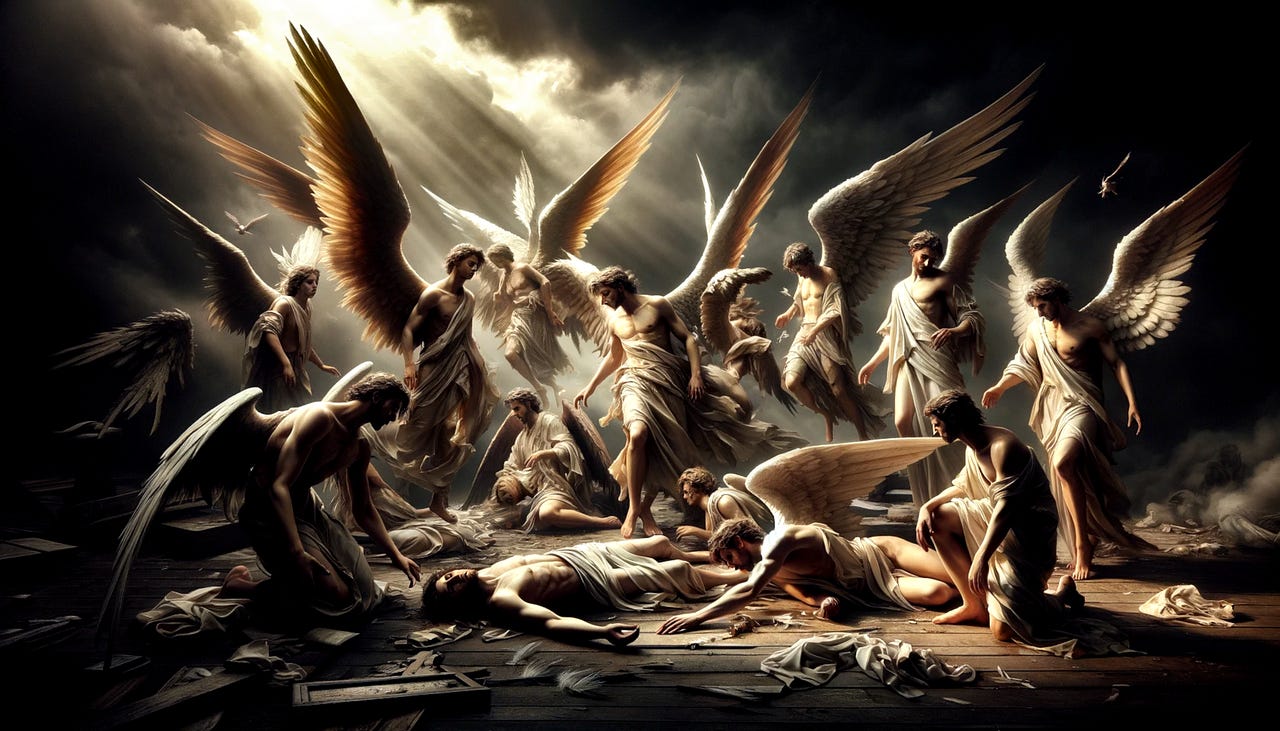
The Text They Don't Want You to See
Genesis 6:1-4 says the “sons of God” saw that human women were beautiful, took them as wives, and fathered the Nephilim. Since Augustine, the church has preferred a sanitized reading: godly men from Seth’s line marrying ungodly women from Cain’s line. It’s neat, moral, and completely impossible if you actually read the text.
The passage never mentions Seth or Cain. The phrase “sons of God” appears throughout the Old Testament referring to divine beings, not human men. Job uses it for angels. The Psalms use it for the divine council. Every Jewish source before Christianity understood it the same way: angels violated cosmic boundaries. First Enoch elaborates it. The Dead Sea Scrolls assume it. When 2 Peter and Jude reference it, they’re talking about angels who “left their proper dwelling.”
This wasn’t fringe theology. This was baseline cosmology.
The Nations Were Divided to the Sons of God
Deuteronomy 32:8-9 says that when God divided the nations at Babel, he apportioned them “according to the number of the sons of God.” Except your Bible probably says “sons of Israel,” which makes zero sense because Israel didn’t exist at Babel.
The Dead Sea Scrolls read “sons of God.” The Septuagint reads “sons of God.” The original Hebrew said God divided the nations among divine beings. Later scribes changed it because they were uncomfortable, and also because the first 300 years of Jewish and Christian relations were not - shall we say - on friendly speaking terms.
At Babel, God didn’t just scatter humanity. He disinherited them, placing rebellious nations under spiritual governors. Each nation got a deity. God kept Israel for himself.
This is why Paul talks about spiritual rulers in heavenly places. Why Daniel sees angelic princes fighting over nations. It’s the framework that makes sense of everything from the plagues of Egypt to the Great Commission.

Why This Matters Beyond Academic Curiosity
When I was deep in paganism, trafficking with entities I didn’t understand, praying to gods whose names I barely knew how to pronounce, I was effective. The rituals worked. Not because I was tapping into cosmic energy or unlocking ancient wisdom, but because there are actual spiritual beings that respond when you open doors. The enemy whispers confidence while tightening chains.
The church’s move away from the supernatural worldview hasn’t made believers more sophisticated. It’s made them functionally blind. We treat spiritual warfare like a metaphor for personal discipline. We pray like we’re talking to ourselves with better intentions. We approach the Christian life as self-improvement rather than recognizing we’re in occupied territory, claimed by the Father through Christ’s blood but still contested by powers that want us ignorant of their existence.
Paul told the Ephesians they wrestle not against flesh and blood but against rulers, authorities, and cosmic powers of darkness. He wasn’t being poetic. He was describing reality. There are actual spiritual beings with actual territorial authority, and they are actually hostile to God’s purposes. When you pray for a nation, you’re not sending good vibes. You’re engaging in warfare with the principality assigned to govern that nation.
This is why the recovery of Scripture’s supernatural worldview isn’t academic navel-gazing. It’s essential for basic Christian faithfulness. You can’t fight an enemy you don’t believe exists. You can’t engage in warfare when you think the battlefield is imaginary.

Let the Text Speak
Here’s my challenge: read Scripture like the ancient authors wrote it. Stop forcing it through Enlightenment categories it was never meant to fit. The divine council is real. Angels rebelled. Spiritual beings govern nations. Demons aren’t metaphors for psychological states. The powers and principalities aren’t abstractions.
The universe is stranger, more dangerous, and infinitely more wonderful than your theology professor wants to admit. The war is real. The stakes are cosmic. And we serve the One who has already won, even as our participation in the battle matters immensely.
The pagans understood one thing the modern church has forgotten: the veil is thin, and there are forces on the other side. Where they went wrong was thinking they could control those forces, thinking they were speaking to entities that had their best interests at heart. But they were right that the supernatural is real.
Scripture agrees with them. It just reveals who’s actually pulling the strings behind those false gods, what the cost of that trafficking really is, and who the only King is that can liberate us from powers we can’t defeat on our own.
You want to know why Genesis 6 and Deuteronomy 32 matter? Because you’re living in the aftermath of both events. The nations are still under hostile administration. The corruption from angelic rebellion still echoes. And Christ is still in the business of reclaiming territory.
The question is whether you’ll recognize the war you’re in.
Let us pray.